
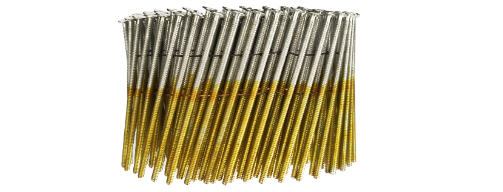
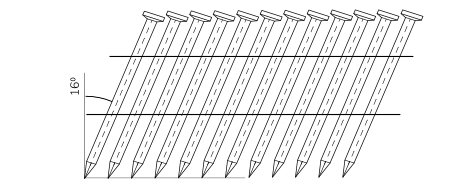
Collation angle: 16°
Diameter: 2.1 mm, 2.5 mm, 2.8 mm, 3.1 mm, 3.4 mm
Length:
2.1 mm - (22 mm, 25 mm, 27 mm, 30 mm, 32 mm, 35 mm, 38 mm, 40 mm,
45 mm, 50 mm, 55 mm - JUMBO collation system available)
2.5 mm - (35 mm , 40 mm, 45 mm, 50 mm, 55 mm, 60 mm, 65 mm, 70 mm
- JUMBO collation system available)
2.8 mm - (60 mm, 70 mm, 80 mm, 90 mm - JUMBO collation system
available)
3.1 mm - (80 mm, 90 mm, 100 mm)
3.4 mm - (65 mm, 70 mm, 80 mm, 90 mm, 100 mm, 110 mm, 120
mm)
Material / finish: uncoated steel, electro-galvanised, hot-dip galvanised or stainless steel nails
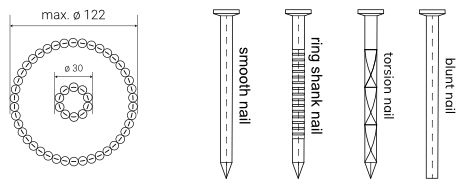
Shank type: smooth, ring or screw; head: round
Point type:sharp, blunt or clinch
Nail type:smooth, ring, galvanised smooth or galvanised ring
Additional information:
roofing nails are also available;
nails with various
specifications are available on request
Wire-collated structural nails, usually assembled into 16° coils, are
versatile fasteners designed for rapid machine-driven installation
using coil nailers. Wire collation allows a very large number of
nails—often between 200 and 400—to be loaded into a single magazine.
This capacity significantly reduces downtime on construction sites and
production lines by eliminating the need to reload the tool
frequently. The robust metal collation ensures coil stability and
reliable fastener feeding under all working conditions.
These fasteners are a standard solution in the mass
production of wooden packaging, Euro pallets and shipping crates,
where productivity and uninterrupted operation are essential. They are
also widely used in timber-frame construction and roofing,
particularly for installing roof sheathing, formwork and OSB boards,
as well as for fastening soffits and timber cladding.
To
optimise the connection for the required loads, coil nails are
manufactured with smooth, ring or screw shanks. Profiled versions
provide consistent withdrawal resistance, preventing components from
loosening as the timber moves naturally. Depending on the structure’s
service environment, the fasteners are supplied in uncoated steel,
with an electro-galvanised coating that protects against corrosion, or
with a hot-dip galvanised coating that provides long-term resistance
to outdoor weather conditions.